Krista's Herbarium
a collection of herbal remedies, recipes, and reveries
Perfume 101
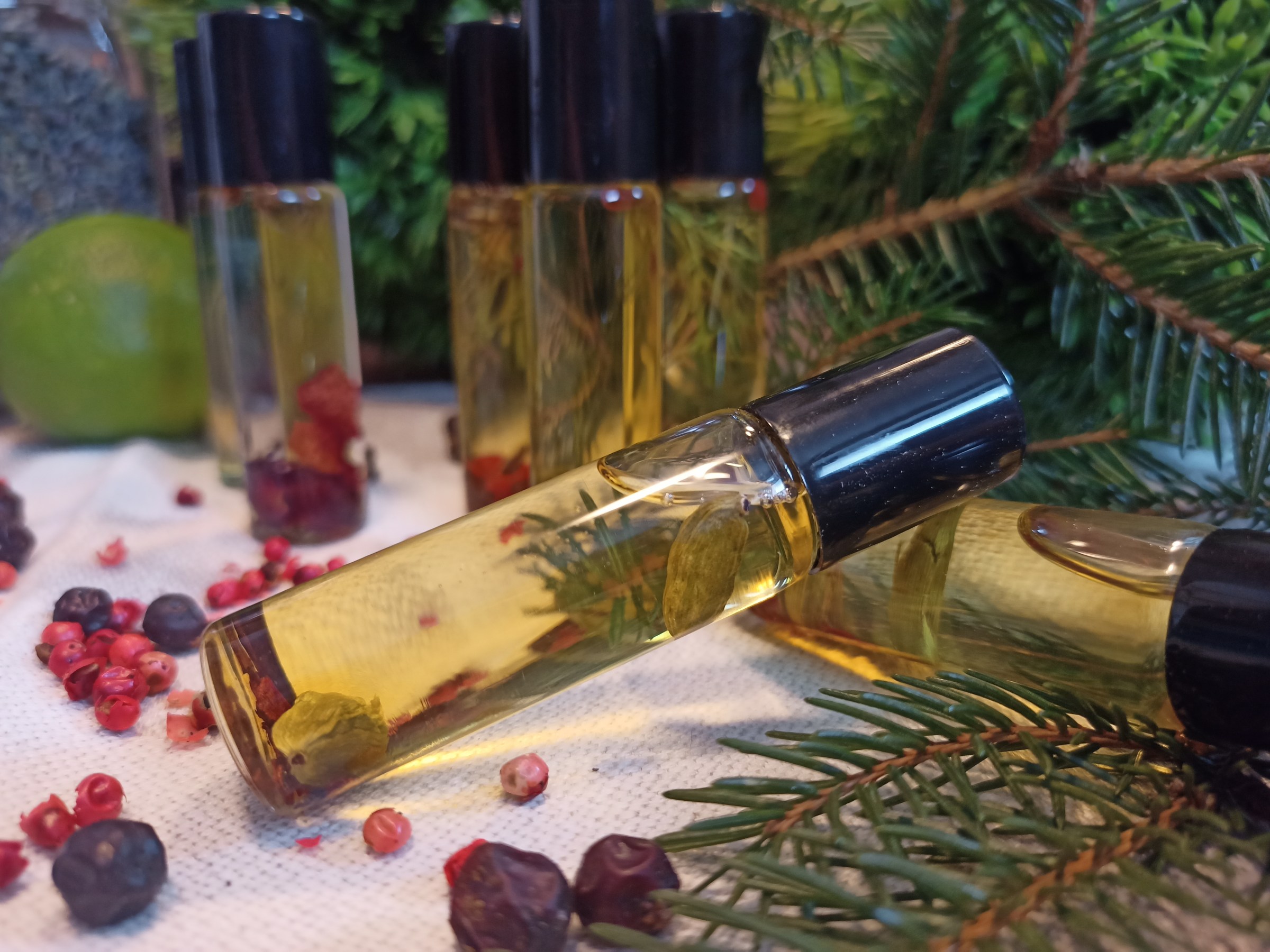
“Perfume is the nourishment that stimulates my thinking.
”
Muhammad

The idea of wearing the fragrance of my garden or the essence of the healing herbs that will nourish me during my day began with making healing blends for headache, joint pain or insomnia. Though these fragrances were used medicinally, there was no doubt that they were more vibrant and delightful than most perfumes I had worn before.
After making my first blends strictly based on fragrance, I thought it would be amazing to combine the use of essential oils medicinally and the idea of wearing a fragrance daily. The idea of choosing a perfume based on your physical, emotional and spiritual needs that day is compelling. I was bewitched by the plant material deftly swirling in the liquid when gently shaken. The whole thing is magical to me.
I am keen to put together over the course of a few articles a complete process for creating and choosing a fragrance that can be beneficial on many levels.
We know in our family that if you are stressed, experiencing a panic attack or in shock, that you reach for lavender essential oil, a couple of drops in your hand and deeply inhale. So, a formula with lavender would be useful for a day when you feel delicate, easily over stimulated, or going into a stressful situation.
Let’s begin…
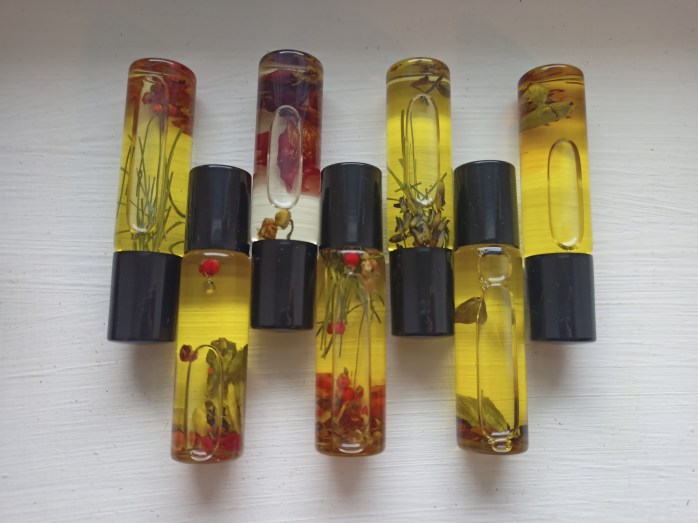
Things you’ll need:
- Essential oils
- Carrier oil: something light with no scent like jojoba oil, sweet almond oil or grape seed oil
- Clear, amber or blue 10 ml glass roll-on bottles (use clear because it looks so pretty with the flowers and other plant material floating in the perfume, but the scent will degrade much more slowly in a coloured bottle)
The art of perfume making is mastered over years, yet the process of blending essential oils for healing and fragrance can, and should, be available to all of us. It is at its heart a simple process.
- First: know your oils and what their healing actions are.
- Second: know yourself (or your clients) and what your (or their) needs are
- Third: use your nose and your heart…what resonates with you (or your clients)
- Fourth: use a blending factor chart to make the experience more efficient and effective
How to begin:
Choose your essential oils based on healing needs and fragrance. Using the blending factor chart, add no more than 10-12 drops of total EOs into the 10 ml glass bottle. Swirl the bottle around to thoroughly combine the oils then fill the rest of the bottle with a carrier oil of your choice. replace the cap and swirl again.
The oils will bloom over time. After a week or two, the scent will really begin to shine!
What is a blending factor?
A blending factor is basically a scale from 1-10 that rates oils on the intensity of their scent. Using blending factors allows you to create blends where one oil doesn’t overpower the rest. This blog post about blending factors from A Mountain Hearth Witch is amazing at explaining the math behind the art of blending perfumes.
Krista’s Herbs Spring Blends:
Bright: notes of bergamot, sweet orange, grapefruit and rosemary
Forest: notes of mint, rosemary, lemon, sage and pine
Sweet: notes of rose, neroli and ylang ylang
Grassy: notes of rosemary, mint and lavender
Sensual: notes of cinnamon, patchouli, clove and cardamom
Earthy: notes of patchouli, hinoki wood, vanilla and cedar
Heaven: notes of lemon, lime and vanilla
Bee Petting: Autumn Edition
The cooler days mean sleepy bees. This one makes a vague suggestion of annoyance at the end by half-heartedly lifting one leg at me.
Yoga

It’s been a long time since I’ve done yoga, maybe fifteen years. I used to really like doing yoga, it suited me and I remember my little girls bending, folding and stretching with me occasionally.
I’ve talked before about how I battle with stress and the effects with which it comes. I work with herbs in my daily life and these help to keep me grounded. I try to get out into the forest every day. This also helps.
As I get older, I’ve been noticing my joints creaking (yikes!), my knees feel delicate and, in general, I feel less flexible and more achy. After some thought, it seemed like a great time to pick up yoga again. If not for anything else but to get more flexible and to spend some quiet time breathing. Sounds like a great idea, no?
Upon buying a proper yoga mat, I started my first day of a 31-day program online. No way was I going to march my old butt into a yoga studio. No one wants that….no one.
It feels super comfy at home in my pjs doing yoga. I’ve been yogaing and breathing every morning before work and it really seems to be helping my mental state. I get into to work with my body coursing with blood that is properly oxygenated, mental clarity and an appropriate sense of detachment from the intensity of other people’s issues that would’ve normally stuck to me like glue.
Just saying…seems to be a good decision. Knees feel better, too!
Here’s where I’ve been doing my yoga:
Nettles To The Rescue

Need an energy boost? Feeling dull due to the change in weather? Now is the perfect time to harvest these gorgeous plants!
Stinging Nettles (Urtica dioica) are in their second growth right now. Catch them before their catkin-like flowers start to dangle. I harvest the top 10-15 cm of the plant and dry them in batches in my dehydrator. I absolutely love them fresh as well. During this change in season, and the stress of starting school again after a luxurious summer holiday, we make nettle tea each evening in order to have a strong brew ready in the morning. I fill our two large French presses 1/2 full of fresh nettles (or 1/3 full of dried), cover them with water that has just boiled and leave them overnight. In the morning, I press them and pour them into glass bottles to be drunk throughout the day. A great tonic, energizer, full of minerals and nutrients and an overall detoxifier!
The Design Process
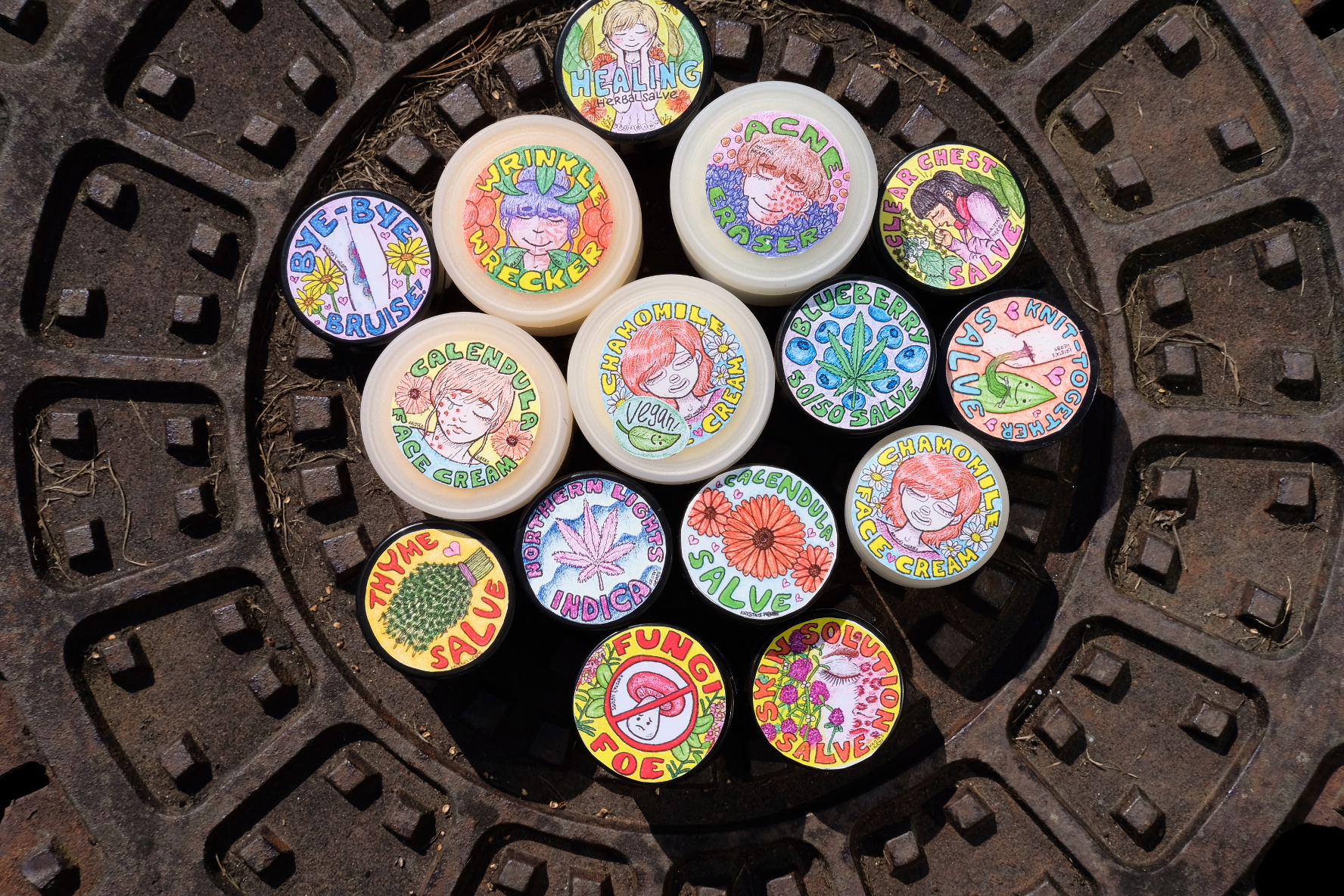
Something that sets my herbal remedies apart is the connection they have with my daughter Rebekah. I began my herbalism journey in order to find a natural path of healing for her and her serious health issues (read more here) and she has partnered with me in designing my labels as well as illustrating all of the designs.
I wanted to share with you the design process. It is truly a delight to watch.
Step 1: We talk together about the remedy, its name, the ingredients and what it is for. She asks some questions, I give a few ideas and then she’s off to do a pencil mock-up.


Step 2: Once I’ve approved the designs and she’s made any necessary corrections, she moves on to inking the designs. Typically, she inks in the remedy titles first. I love this part, it’s like watching them come to life.


And more inking….


Step 3: Once the inking is done, she moves on to colouring. Using high-quality coloured pencils, she breathes life into the designs.


Step 4: Final look at the new batch of labels!


Step 5: My youngest daughter Roxie is also a valuable part of my herbal business. She is in charge of formatting and processing the digital images in order to get them ready to go to the printer.


Step 6: Rebekah then takes the digital images and gets them printed on waterproof, removable sticker paper.


Step 7: The mind-numbing task of cutting out the labels often goes as well to Rebekah. Binge watching a TV show goes well with this task.


Step 8: Filing away the pre-cut labels along with their ingredients stickers and keeping it all organised is super important.


Step 9: Affixing the labels on to new products. I am so proud of Rebekah and her designs!


The Wise Woman Way

These are the ways of our ancient grandmothers, the ancient ones who still live. These wise women are one with all life as they tread the ever-changing spiral. Every pain, every plant, every stone, every feeling, every problem is cherished as teacher: not teacher who grades, but teacher who guides. Night is loved for darkness and the stars. Day is loved for light and the sun. Uniqueness is our treasure, not normalcy. Our universe includes it all; it is ‘both/and,’ not ‘either/or.’ This is the Wise Woman way the world ‘round’
-Susan Weed
Photo credit: design-dautore.com
Bye Bye Bruise!


Day 1: Walking into the kitchen, I slipped and banged my wrist on the corner of the wall, hitting the bone in such a way that it took my breath away. I am using it as an opportunity to show the power of arnica in these situations. I applied my Bye Bye Bruise Salve which contains arnica-infused olive oil, beeswax, and rosemary, lavender and fennel essential oils. This salve has rubefacient, vulnerary and analgesic actions.
If put on directly after an injury, it is really helpful!

Day 2: no pain and looking better
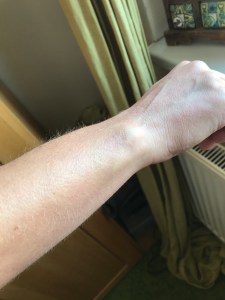
Day 3: almost all gone!

Day 4: wouldn’t even know it had happened!
This salve is a staple in our home first-aid kit.
Would you like to buy it directly from me? Shop here.
Making New Friends



On the way to Vienna, this little green buddy hopped a ride from České Budějovice. He stayed with me even on the subways in Vienna. I’m in my hotel room and he’s crawling around my head while I’m typing this.
Update: He stayed with me for the whole day and then I released him on a happy bush outside our apartment in Vienna. I looked for him everyday, wondering if he’d like to score a ride back to Czech. He seems happy in his new country….
Mullein
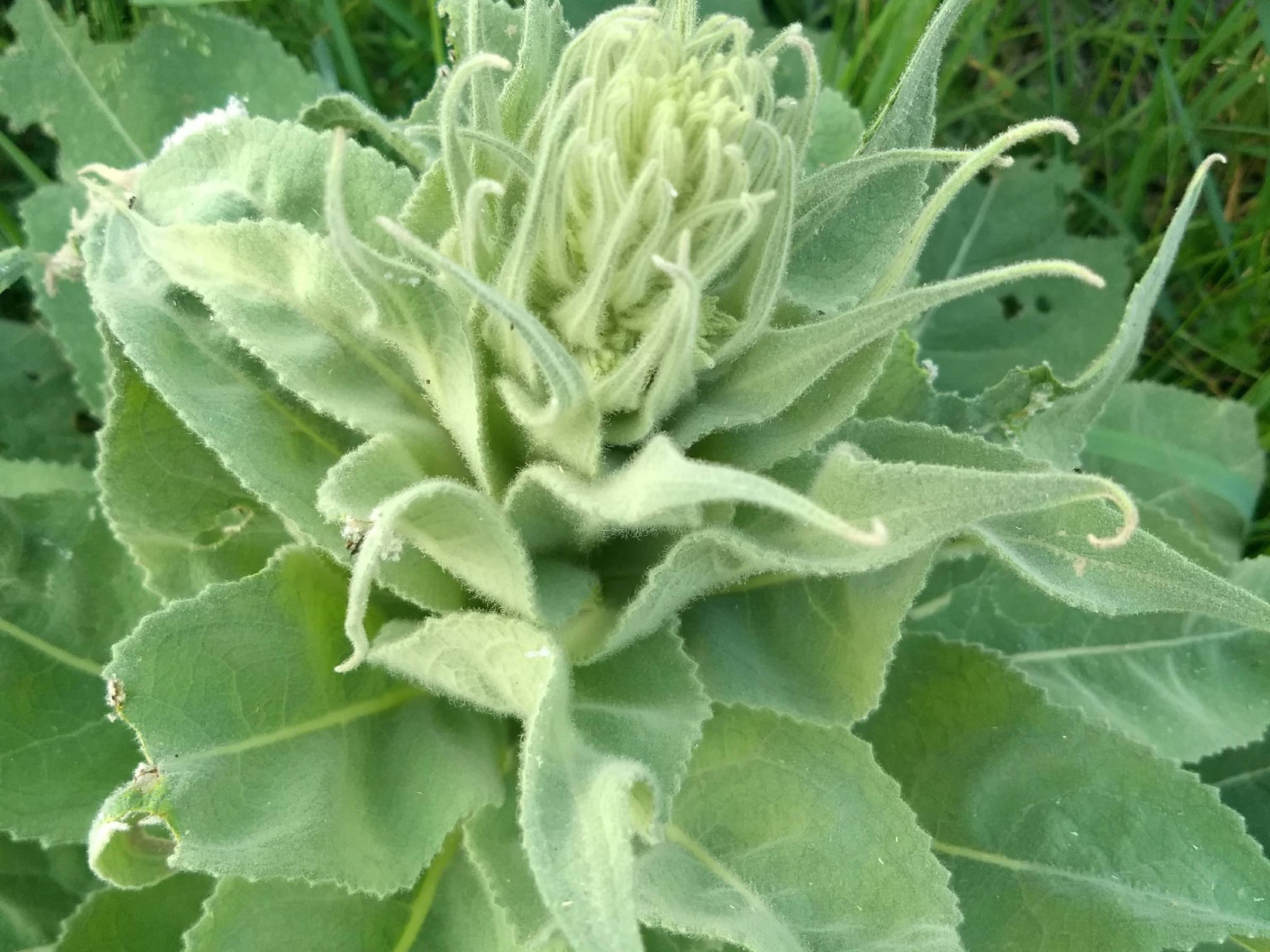
Verbascum thapsus
Medicinal Notes
| Lyte (The Niewe Herball, 1578) tells us ‘that the whole toppe, with its pleasant yellow floures sheweth like to a wax candle or taper cunningly wrought.’ |
Our family has a lot of personal experience with mullein. It is one of our Great Eight here in South Bohemia. I love harvesting its first year leaves, using them in teas for respiratory illness, crushing them up into soothing poultices for wounds and relying on them to calm my cough, ease the pain and make it productive. Gathering its delicate flowers takes days. Once the stalk is flowering, one must gather daily to capture the flowers at the perfect state, which is as a partially closed bud. Beware, though, as these flowers are small hotel rooms for a myriad of insects and I have surprised many in my gathering. The flowers are set up in oil and are pretty darn near flawless in their assistance with earaches and ear infections. My husband had a painful ear infection a couple of weeks back, the kind with a shooting pain that would render him near speechless; he applied the oil to his ear canal two times a day for 20 minutes or so and felt dramatic improvement in a couple of days.
There is something really special about standing in front of a mullein spike mid-summer, gently coaxing insects out of the flowers cum hidey-holes, popping the popcorn like buds from their sockets, knowing that tomorrow you will be back for more.
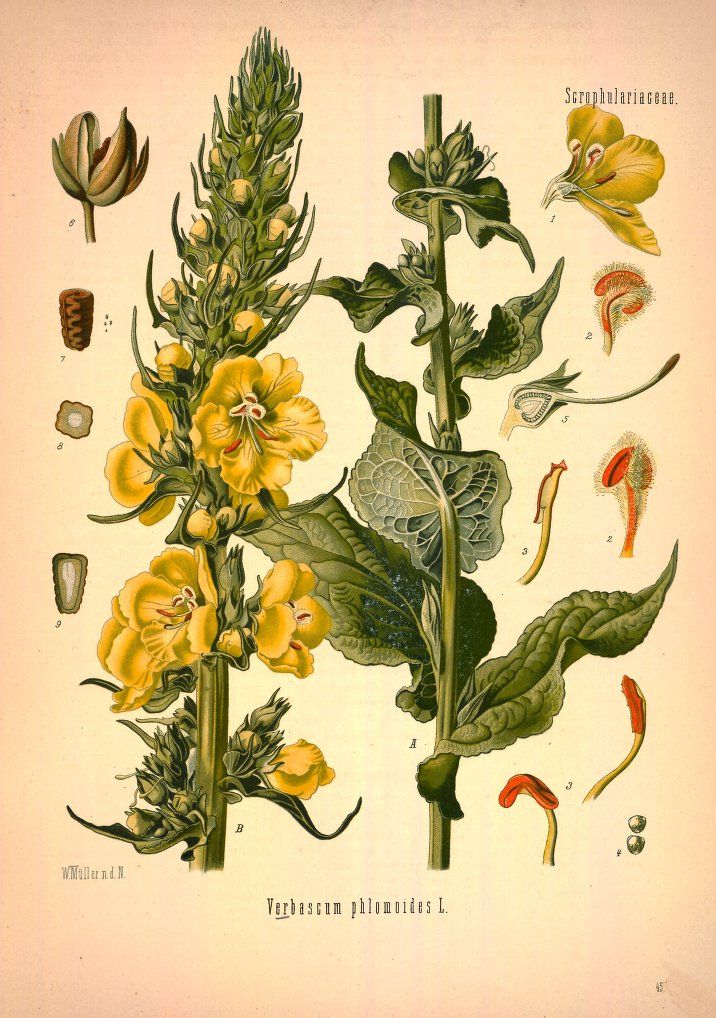
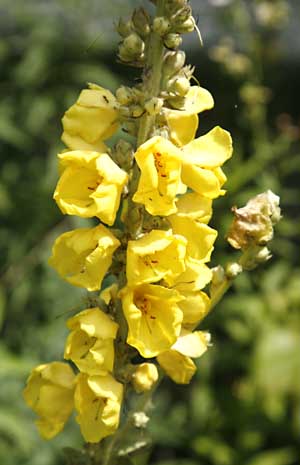
Mullein is a beautiful biennial. The first year the plant grows a rosette of leaves that are 6 to 8 inches long and covered with fuzzy hairs which make them feel thick and soft to the touch. The second year of growth it sends up a stalk that is 4 to 5 feet tall. The leaves grow alternately up the stalk and get smaller as they near the top. A spike of flowers grows on the top. The sulphur-yellow flowers, nearly an inch across, are formed of four or five petals that unite at the base to form a short tube.
According to herbalist Richard Whelan:
“Mullein was described as a treatment for ‘old coughs’ by the Greek physician Dioscorides over 2000 years ago and has chiefly been used as a herb for lung problems since well before then till now.
Ancient cultures around the world considered Mullein a magical protector against witchcraft and evil spirits and like many such herbs used in magic Mullein has a long history as a healing plant. The botanical family name for Mullein; Schrophulariaceae is derived from scrofula, an old term for chronically swollen lymph glands, later identified as a form of tuberculosis.”
Harvesting
Mullein leaves are best harvested in the summer of the second year as the plant is growing its stalk. Bundle and hang the leaves upside down to dry. Harvest the buds and flowers when in bloom (Usually between July and September) and use them fresh or dried. Roots can be gathered before the stalk grows, sliced and dried.
Watch one of my herbal heroes, Susun Weed harvest mullein here.
Constituents
Mullein contains rotenone, mucilage, gum, saponins, essential oils, flavonoids, glycosides.
Uses
Internally, as a tea, infusion, or tincture:
For digestion, mullein soothes the gut, eases peptic ulcers and curbs diarrhea.
Mullein is a heavy hitter with the immune system. As a soothing expectorant, it gently calms and moistens dry, hacking coughs, sore throats as well as more intense inflammatory conditions such as pharyngitis, tracheitis and bronchitis. It is antiseptic and relaxing; quite effective for colds, flu and chest infections. As a decongestant it clears phlegm, sinusitis and hay fever.
Mullein enhances the immune system. With an anti-inflammatory action, it aids in relieving the pain of swollen glands and mumps. It is useful against influenza strains and herpes simplex because of its antibacterial and antiviral actions.
It is often used as a remedy for urinary system complaints. Mullein acts as a soothing diuretic for burning and frequency of cystitis and fluid retention. It increases the elimination of toxins, while being useful for arthritis, rheumatism and gout.
Externally, mullein is used as a healing salve or poultice for wounds, burns, sores, ulcers and piles. A compress of leaves can be used for painful and swollen joints, sore muscles, asthma, headaches, and swollen glands. The topical application of mullein flowers or flower oil speeds healing of ringworm and other skin infections. Mullein flower oil is used as an effective remedy against earaches and ear infections.
According to herbalist jim mcdonald:
“The leaves are the most commonly used part of the plant, and among the first remedies to be thought of in treating congestion and dry coughs, as they are an excellent expectorant. An expectorant aids the lungs in expelling mucous and phlegm by loosening it from the walls of the lungs and allowing it to be coughed up; thus, Mullein will stimulate coughing, even though that’s the symptom being treated. What Mullein is really doing is assisting the body’s natural response to congestion – coughing – to be more effective.”
According to herbalist Kiva Rose:
If there’s one thing Mullein is famous for, it’s as an oil for ear infections. The warm oil is useful where wax is causing a blockage and/or pooling of moisture but in general, I prefer the flower tincture for most infections, as it adds the drying action that helps to speed healing form most bacterial infections. Additionally, I find Mullein flower to be much more effective in the treatment of chronic ear infections when combined with Elderberry tincture. Be aware that if there is any chance of a ruptured ear drum, nothing at all should be placed in the ear and immediate medical attention should be sought. Also, if chronic ear infections persist with herbal treatment, a dairy intolerance should be considered and/or probiotic therapy in the form of fermented foods or supplementation.
Tincture: 1-4 ml (1:5 in 60%) 3x per day.
Tea: 1-2 teaspoons dried leaf per cup boiling water, steeped for 10-15 minutes, taken three times per day.
External applications: poultice, salve, or wash as needed.
Mullein is considered a very safe herb. One should be cautious about interacting too intimately with the fuzzy little hairs on the leaves as they can cause contact dermatitis.

 Krista's Herbarium